Introduction
Virtual reality headsets have become a popular way to experience immersive games, interactive fitness sessions, virtual environments, and social applications. Devices such as the Meta Quest 3S, Meta Quest 3, and Meta Quest 2 allow users to explore VR without relying on a traditional gaming computer for every experience. However, keeping a VR setup organized involves more than storing the headset itself. Controllers, charging cables, optional head straps, and other accessories can quickly occupy desk space or end up scattered around a room.
A dedicated charging station can help bring these components together in one location. Instead of leaving a headset on a table and charging its accessories separately, users may prefer a vertical stand that provides a designated place for their equipment between sessions.
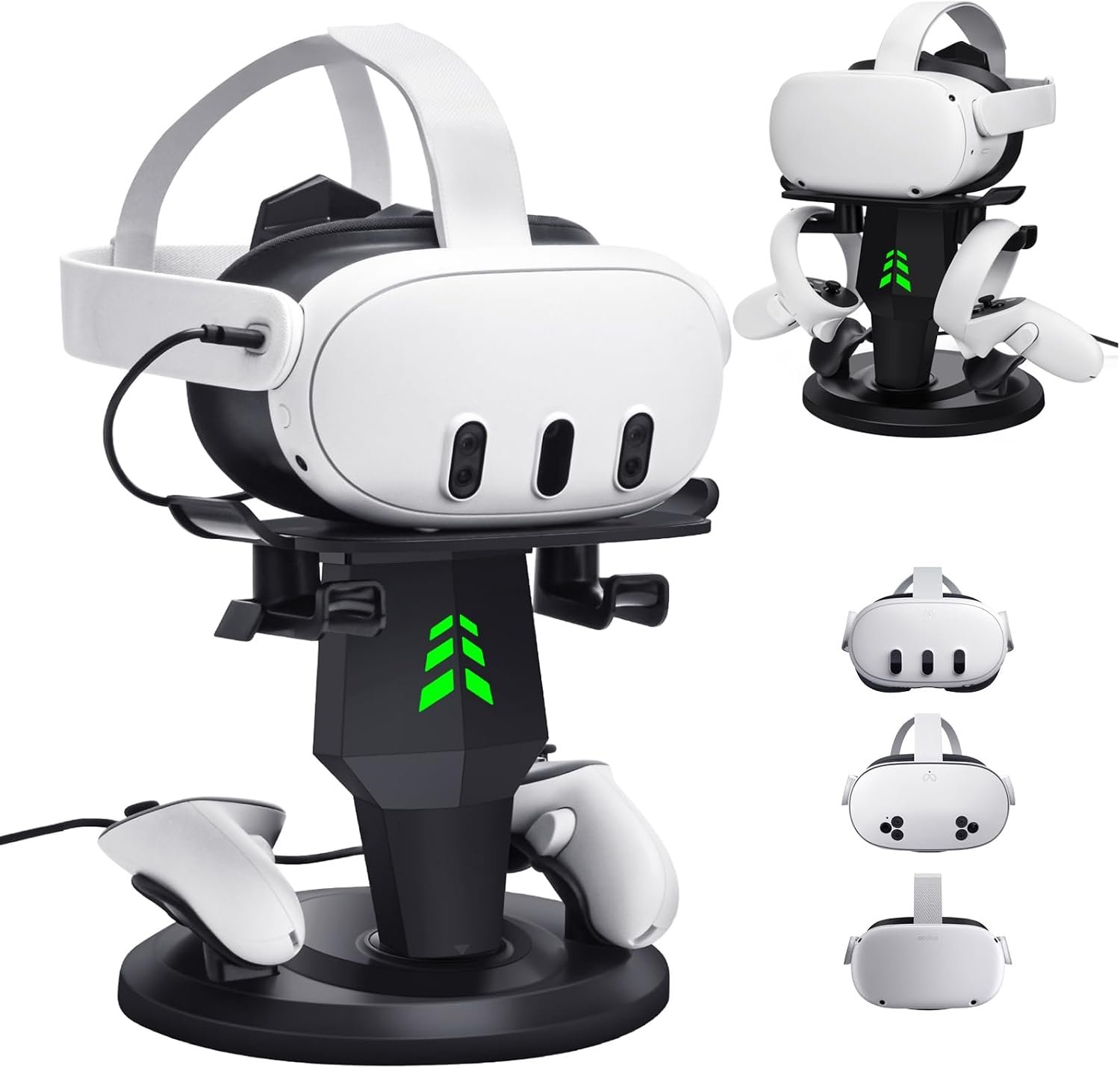
The TechKen VR Charging Dock for Meta Quest 3S, Quest 3, and Quest 2 is designed around this idea. Its product description identifies it as a vertical VR stand and charging station intended for compatible Meta Quest headsets. The listing also highlights a Type-C cable, fast-charging functionality, and support for controllers with grip covers and Elite-style straps.
These features may appeal to VR players who use their headsets regularly and want a more organized way to store and charge their equipment. At the same time, compatibility, charging requirements, accessory dimensions, and the space available on a desk are important considerations before choosing a charging dock.
This guide explores the advertised features of the TechKen VR charging dock, practical ways to incorporate it into a VR setup, the differences between common storage and charging solutions, and the limitations worth understanding before making a decision.
What Is the TechKen VR Charging Dock?
The TechKen VR charging dock is a charging and storage accessory designed for selected Meta Quest virtual reality headsets. According to the product title, it supports the Quest 3S, Quest 3, and Quest 2 and combines a vertical stand with charging functionality.
A charging dock generally provides a designated location for compatible electronics while supplying power through a supported charging connection. In a VR setup, this can help keep the headset and controllers together when they are not in use.
The TechKen model is also advertised as accommodating controllers with grip covers and Elite-style straps. This detail may matter to users who have modified their VR equipment for comfort, stability, or a different gaming experience. However, the fit of a particular accessory combination should be verified against the current product listing and any supplied compatibility information.
The product title mentions a Type-C cable and fast charging. Those terms describe intended features, but they do not establish a specific charging speed or guarantee compatibility with every power adapter. Actual charging performance depends on the dock’s electrical design, the connected power source, the headset’s charging requirements, and any restrictions described by the manufacturer.
A charging station is also different from a battery replacement or a device that increases the headset’s internal battery capacity. Its primary role is to provide a convenient place to store and charge supported equipment.
Before selecting the TechKen dock, it is sensible to check the exact items included in the package, the required power supply, the supported headset configurations, and the installation instructions.
Key Features of the TechKen VR Charging Dock
1. Compatibility With Multiple Meta Quest Headsets
The product title lists compatibility with three headset models: Meta Quest 3S, Meta Quest 3, and Meta Quest 2.
Supporting several headset generations can be useful for households where different people own different Quest devices. It may also be relevant to users who upgrade their headset but want to retain a charging accessory, provided the new device remains within the dock’s documented compatibility range.
However, compatibility should not be interpreted as proof that every configuration fits identically. Headsets can differ in their dimensions, charging-port placement, facial interfaces, and optional accessories.
Before using the dock, confirm the manufacturer’s instructions for the exact headset model. Check whether any required connector, adapter, or positioning step differs between the Quest 3S, Quest 3, and Quest 2.
Users who own a third-party head strap, protective shell, facial interface, or battery accessory should pay particular attention to the supported configuration. An accessory that changes the headset’s shape may affect how securely it sits on a stand.
2. Vertical Storage Design
The TechKen dock is described as a vertical VR stand. A vertical arrangement can help consolidate equipment within a defined footprint, rather than spreading a headset and its accessories across a desk.
For a home gaming area, this can make the VR setup easier to identify and put away after use. It may also help keep the headset away from loose objects, books, and other items that could press against its lenses or straps.
A vertical stand is not automatically more space-efficient in every room. Its overall height, base dimensions, and stability matter, particularly when it is placed near a monitor, keyboard, or other frequently used equipment.
Users should select a flat, stable surface and leave enough clearance to place and remove the headset without hitting nearby objects. The stand should not be positioned where someone could easily knock it over while walking past.
3. Charging Station Functionality
A charging station combines storage with a way to supply power to compatible equipment. The TechKen product is advertised as a VR charging dock rather than a stand intended only for display.
The practical advantage of this arrangement is convenience. Users can keep their headset in a consistent location and connect it to charging when a session ends, reducing the need to search for cables or move equipment around the room.
The exact charging arrangement matters, however. Some docks use a direct connector, while others rely on a separate cable or accessory. The product’s current documentation should explain how the TechKen dock connects to the headset and which parts must be aligned during placement.
Users should not force a charging connector into a port or assume that a headset is charging merely because it is resting on the stand. Confirm the connection and check the headset’s charging indicator or other manufacturer-provided status information.
4. Type-C Cable
The product title identifies a Type-C cable as part of the charging arrangement. USB Type-C is a connector standard used by many modern electronic devices, including compatible VR headsets and accessories.
The presence of a Type-C cable does not, by itself, specify the charging power delivered to the headset. Cable capability, connector arrangement, the dock’s internal electronics, and the power adapter all influence the charging process.
It is also important to distinguish the shape of a connector from the capabilities of the equipment connected to it. Not every USB-C cable supports the same data rates or power levels, and not every USB-C accessory works with every device.
Check whether the supplied cable is intended for the dock’s power input, the headset connection, or another part of the system. Follow the manufacturer’s wiring diagram rather than substituting an arbitrary cable arrangement.
5. Advertised Fast-Charging Support
The TechKen product title describes the station as supporting fast charging. This may be relevant to users who want their headset ready for another session without leaving it connected for longer than necessary.
However, charging speed is determined by the complete charging system, not by a marketing term alone. The power adapter, cable, dock circuitry, headset charging system, battery temperature, and current battery level can all influence the time required.
The headset may also regulate charging as part of its normal battery-management process. As a result, charging performance may vary between models and usage conditions.
Prospective users should look for specific charging specifications in the product documentation. If the listing does not provide a clear power rating or measured charging time, it is better not to assume a particular number of watts or a guaranteed charging duration.
For everyday use, the main consideration is whether the dock provides a compatible and convenient charging method that meets the manufacturer’s requirements for the headset.
6. Support for Controllers With Grip Covers
Many VR users add grip covers or controller straps to improve handling. These accessories can change the controllers’ dimensions and may influence whether they fit in a charging or storage cradle.
The TechKen dock is advertised as supporting controllers with grip covers. This feature may be useful for players who prefer additional grip material or a more secure hold during active games.
Nevertheless, grip covers vary in thickness, shape, and placement. A dock that accommodates one style may not necessarily fit every third-party cover.
Check the product photographs, listed compatibility details, and any restrictions on controller accessories. If the manufacturer identifies supported dimensions or specific accessory types, use those details to assess whether a particular setup is likely to fit.
Avoid pressing a controller into a cradle if the grip cover causes resistance. A poor fit can make storage less convenient and may place unnecessary pressure on the controller or dock.
7. Compatibility With Elite-Style Head Straps
The product title also mentions support for Elite straps. Head straps can affect how a headset sits on a stand because they may add bulk, extend behind the head, or incorporate a battery compartment.
For users who have upgraded their headset’s head strap, compatibility can be more important than it is for someone using the original configuration. A stand that accommodates the headset alone may not leave enough clearance for an aftermarket strap.
The TechKen dock is advertised for configurations involving Elite-style straps, but the exact supported products and dimensions should be verified. Not every strap sold under a similar description has the same shape.
Before placing a headset on the dock, make sure the strap does not interfere with the charging connection or cause the headset to rest at an unstable angle. If the strap contains an additional battery, confirm whether that accessory has a separate charging requirement.
8. A More Organized VR Setup
Beyond charging, a dedicated station can provide a consistent place for the headset and controllers. This can help users maintain a tidier desk and reduce the likelihood of accessories being misplaced between sessions.
A predictable storage routine can also make it easier to notice when a controller, cable, or other component has been left somewhere else. In a shared household, a designated location may help everyone return the equipment to the same place.
Organization alone does not protect a headset from every type of damage. Users should still avoid direct sunlight on the lenses, excessive heat, moisture, and situations in which equipment can be knocked off the stand.
The charging station should be viewed as one component of a broader storage routine rather than a replacement for the headset manufacturer’s care recommendations.
How the TechKen VR Charging Dock Can Be Used
1. Creating a Dedicated VR Charging Area
One straightforward use is to establish a permanent place for the headset and controllers. The dock can be positioned on a desk, shelf, or gaming station where the equipment is accessible but not in the way of everyday activities.
Choose a surface that is level and stable. Leave sufficient room around the dock so the headset can be placed on it without touching a monitor, wall, or other equipment.
Cable routing is also worth considering. A cable that crosses a walking path or hangs over the edge of a desk can create a tripping or snagging risk. Keep cables arranged so they do not pull on the dock or charging connector.
If the station is placed near a computer, make sure it does not block ventilation openings or interfere with other equipment.
2. Preparing for the Next VR Session
A charging dock can be incorporated into a simple routine after gaming. When a session ends, users can return the headset and controllers to their designated locations and connect the equipment according to the manufacturer’s instructions.
The benefit is consistency rather than a guaranteed increase in battery performance. A regular routine may make it easier to see which components need charging and which are ready for use.
Before starting a new session, check the headset’s battery indicator and confirm that the controllers have adequate power. The dock should not be assumed to charge every component automatically unless the manufacturer explicitly documents that function.
Users should also allow equipment to cool as recommended if it has become unusually warm during use. Do not cover the headset or its ventilation openings while charging.
3. Organizing a Shared Family VR Setup
In households where several people use the same VR system, equipment can become scattered between rooms or gaming areas. A shared charging location may help keep the headset, controllers, and accessories together.
This can be particularly useful when users take turns playing games or using fitness applications. Everyone can return the equipment to the same place rather than leaving it on a sofa or floor.
A shared station should be placed away from areas where children or pets may pull on cables or knock over the stand. Users should also avoid leaving small accessories where young children could access them.
If the household owns more than one headset, confirm whether the dock is compatible with each device before assuming it can serve as a universal charging station.
4. Supporting a VR Gaming Desk
A dedicated gaming desk may include a computer, monitor, keyboard, headphones, controllers, and charging cables. A vertical VR stand can help give the headset a defined place within that arrangement.
When planning the layout, consider the dock’s height and base dimensions as well as the space needed to remove the headset. Placing the stand too close to a monitor or desk edge may make it awkward to use.
Cable management can also help preserve the workspace. Secure excess cable length without bending connectors sharply or creating tension around the charging port.
The dock should remain stable during normal handling. If the desk moves or vibrates frequently, choose a position where the stand is unlikely to slide or tip.
5. Accommodating Compatible Grip Covers
Users who have added grip covers can use the dock according to the supported configuration stated by the manufacturer. The aim is to store the controllers without removing accessories every time the headset is put away.
Before regular use, check that each controller rests securely in its intended position. A grip cover should not block a charging contact or interfere with a connection if the dock uses one.
If the controller does not fit comfortably, do not force it into place. Review the compatibility details and determine whether the cover needs to be removed or whether a different storage arrangement is required.
6. Storing a Headset With an Elite-Style Strap
For users with an upgraded head strap, the dock may provide a convenient place to store the headset between sessions, provided the specific strap configuration is supported.
Check that the strap does not push against nearby surfaces or make the headset lean. If the strap includes a battery or another electronic component, review its separate charging and storage instructions.
Some third-party straps have adjustment mechanisms or rigid components that change the overall shape of the headset. A secure fit should not require bending the strap or placing pressure on the headset’s facial interface.
7. Using the Dock in a Small Room
A vertical stand may help consolidate VR equipment in a compact gaming area. However, small spaces often have less room for safe cable routing and stable placement.
Measure the available surface before setting up the station. Consider the space required to lift the headset off the stand and return it without hitting a wall or another object.
Avoid placing the dock on a narrow ledge or an unstable stack of books. A smaller footprint is useful only if the equipment remains secure and accessible.
Who May Find the TechKen VR Charging Dock Suitable?
Meta Quest 3S Owners
Quest 3S users who want a designated charging and storage location may find the dock relevant because the product title explicitly lists this headset model. Compatibility should still be confirmed against the current product instructions and any attached accessories.
Meta Quest 3 Owners
Quest 3 users may appreciate having the headset and compatible controllers organized together. Those who have installed a third-party head strap or controller grips should check whether the exact configuration fits the dock.
Meta Quest 2 Owners
For Quest 2 owners who continue to use their headset, a compatible charging station can provide a dedicated storage location without requiring a different headset. Verify the precise connection method and any model-specific instructions before use.
Frequent VR Gamers
People who play VR games regularly may value a predictable place to return their equipment after each session. A dock can reduce clutter and make charging part of a consistent routine.
Its usefulness depends on the user’s habits. Someone who stores a headset in a protective case after every session may prefer a different organization method.
Users With Aftermarket Accessories
Players who use grip covers or Elite-style straps may be interested in the TechKen model because these accessories are specifically mentioned in the product title. Still, accessory designs vary, so compatibility should be checked for the exact products being used.
Families and Shared Gaming Spaces
A common charging location may help several users keep track of the same headset and controllers. A stable setup with carefully routed cables can also reduce clutter in a shared room.
The dock should be placed where users can access it safely without creating a hazard for children, pets, or people walking through the area.
Important Things to Consider Before Choosing the Dock
1. Confirm the Exact Headset Compatibility
Although the product title lists the Quest 3S, Quest 3, and Quest 2, the manufacturer’s documentation should be checked for the exact model and supported configuration.
Compatibility may depend on the headset version, charging-port arrangement, required cable, or any adapter included in the package. Do not assume that a dock designed for one Quest model will work with every VR headset.
2. Check the Power Requirements
Charging speed and compatibility depend on the complete power arrangement. Review the required input voltage, current, supported power adapter, and cable configuration before connecting the station.
Do not assume that the word “fast” guarantees a particular charging rate. If a specific charging speed is important, look for documented electrical specifications rather than relying only on promotional wording.
Use a suitable power source and avoid damaged cables, loose connectors, or adapters that do not meet the manufacturer’s requirements.
3. Understand What Is Included
Product photographs may show a headset, controllers, straps, cables, or other accessories for demonstration. Not every item shown in an image is necessarily included with the charging dock.
Read the package contents in the current listing. Confirm whether the power adapter, Type-C cable, controller accessories, or other components must be supplied separately.
This helps prevent confusion during setup and makes it easier to determine whether the dock fits into an existing charging arrangement.
4. Verify the Fit of Aftermarket Accessories
Grip covers and Elite-style straps differ between manufacturers and models. A dock may support certain accessory configurations without accommodating every variation.
If the headset has a rigid protective shell, an extended battery strap, or an unusual controller cover, check the dimensions and compatibility details carefully.
Never force the headset or controllers into a position that causes resistance, instability, or pressure on sensitive components.
5. Consider Stability and Placement
A vertical stand needs a stable surface. Place the dock away from desk edges, narrow shelves, and locations where a cable could pull it over.
Think about the movement required to place and remove the headset. A dock that is difficult to access may be less convenient in everyday use, even if it provides a compact storage arrangement.
If several people share the same room, choose a location that reduces the risk of accidental bumps.
6. Protect the Headset Lenses
VR headset lenses require care. Direct sunlight entering the lenses can concentrate light and potentially damage the display, even if the headset is not being used.
A charging dock should be positioned away from windows or other locations where sunlight may shine directly into the headset. The stand does not necessarily shield the lenses from ambient light.
Follow Meta’s storage guidance, and consider a lens cover if appropriate for the headset and recommended by its manufacturer. Avoid placing anything against the lenses that could scratch them.
7. Manage Heat and Ventilation
Electronic devices can become warm during use and charging. Follow the headset and dock manufacturers’ instructions regarding operating temperature and ventilation.
Do not cover the headset with fabric while charging, place the dock next to a heat source, or use it in a location with poor airflow if the instructions prohibit such conditions.
If the headset, cable, power adapter, or dock becomes unusually hot, disconnect power when it is safe to do so and consult the relevant manufacturer’s support guidance.
8. Avoid Assuming That Every Component Charges Automatically
A charging station may support the headset and provide storage for controllers, but those functions are not always identical. Some docks charge only particular components, while others use separate connections for different devices.
Verify which components the TechKen dock actually charges and how the controllers must be connected, if controller charging is supported. The product title alone should not be treated as confirmation of every possible charging function.
9. Review Warranty and Support Information
Accessories can differ in warranty coverage, return terms, and technical support. Check the current seller and manufacturer information if warranty support is important.
Retain the documentation and any necessary purchase information. If the dock does not connect as described, avoid modifying its electronics or using improvised connectors that could damage the headset.
Comparing General Categories of VR Storage and Charging Accessories
Different VR accessories serve different purposes. Understanding the categories can help determine whether a charging dock fits an existing setup.
Basic VR Stands
A basic VR stand provides a designated place to store a headset and possibly its controllers. It may help reduce clutter and keep equipment off a desk or floor.
Its main distinction is that storage may be the primary function. Charging can still be handled separately using the headset’s normal cable and power adapter.
A basic stand may suit users who already have a preferred charging arrangement or who prioritize simple storage over combining functions.
Dedicated Charging Docks
A charging dock combines a storage position with a charging connection for compatible equipment. This can reduce the number of separate steps required to store and recharge a device.
The TechKen station belongs to this general category based on its advertised charging and vertical stand functions. Its suitability depends on the exact headset model, power requirements, and accessory configuration.
Charging docks can differ in the number of devices supported, connection design, electrical specifications, and whether accessories must be removed before use.
Wall-Mounted Storage Solutions
Wall-mounted VR holders use wall space rather than a desk or shelf. They may help free up a work surface, but installation requires a suitable mounting location and hardware.
A wall holder is not necessarily a charging station. Some designs provide storage only, while others incorporate cable management or charging features.
Users should consider the wall material, mounting instructions, cable routing, and the need to protect the headset from direct sunlight or accidental contact.
Protective Cases
Protective cases are intended to shield VR equipment during storage or transport. They may be useful for people who travel with their headset or prefer to store it away from dust and incidental contact.
A case typically requires the equipment to be removed and packed, and it may not provide convenient charging while the headset is stored. Users should follow the case and headset manufacturers’ recommendations to avoid trapped heat or improper storage.
A charging dock and a protective case therefore serve different purposes and may complement each other, depending on how the headset is used.
Multi-Accessory Charging Stations
Some charging stations are designed to organize several devices or accessories in one location. Their supported devices, connectors, and charging methods can vary widely.
The key consideration is whether the station is designed for the specific headset and controllers rather than whether it simply has several charging ports. Compatibility, power delivery, physical fit, and safe cable routing should all be checked.
These categories are not direct substitutes in every situation. A charging dock may be useful for daily storage, while a protective case may be more appropriate for transport.
Frequently Asked Questions
Which Meta Quest headsets does the TechKen charging dock support?
The product title lists Meta Quest 3S, Meta Quest 3, and Meta Quest 2. Check the current listing and manufacturer’s instructions for exact compatibility details, especially if the headset uses third-party accessories.
Does the dock include a Type-C cable?
The product title mentions a Type-C cable. Review the current package contents to confirm the included cable’s purpose and whether a power adapter or other components must be supplied separately.
Does the TechKen dock support fast charging?
The product is advertised as supporting fast charging. Actual charging performance depends on the dock’s specifications, power source, cable, headset, and operating conditions. Consult the documentation for supported power requirements and any stated charging rates.
Can the dock accommodate controller grip covers?
The product title specifically mentions support for controllers with grip covers. However, grip covers differ in shape and thickness, so check compatibility with the exact covers being used.
Can it be used with an Elite-style head strap?
Elite-style strap compatibility is advertised, but not every strap has the same dimensions or design. Confirm the supported configuration and ensure that the strap does not interfere with the headset’s stability or charging connection.
Does the dock charge the controllers as well as the headset?
The product title describes a charging station and mentions controller support, but storage compatibility does not necessarily mean that controllers are charged by the dock. Check the current listing and manual to determine exactly which components receive power and how they connect.
Can the dock be used while the headset is not in use?
A charging dock is generally intended to hold and charge compatible equipment between sessions. Follow the manufacturer’s instructions for the correct placement, connection, and charging procedure.
Is the dock suitable for a small gaming desk?
A vertical design may help consolidate equipment, but suitability depends on the dock’s footprint, height, cable arrangement, and the space needed to remove the headset. Measure the available surface and ensure the stand can sit securely.
Does the charging dock increase the headset’s battery capacity?
No. A charging dock provides a way to recharge compatible equipment; it does not inherently increase the headset’s built-in battery capacity. Any battery expansion would require a separate compatible accessory designed for that purpose.
Can any USB-C power adapter be used with the dock?
Do not assume that every adapter is suitable. Check the manufacturer’s specified input requirements and use a compatible power source. Connector shape alone does not establish that an adapter provides the correct electrical output.
How should the dock be cleaned?
Follow the manufacturer’s cleaning instructions. Disconnect power before cleaning when instructed, avoid introducing liquid into electronic components, and allow parts to dry as specified before reconnecting them.
Does the dock protect the headset lenses from sunlight?
A vertical stand does not necessarily protect the lenses from sunlight. Store the headset away from direct sunlight and follow Meta’s care instructions to reduce the risk of lens or display damage.
Conclusion
The TechKen VR Charging Dock for Meta Quest 3S, Quest 3, and Quest 2 is designed to combine vertical storage with charging convenience. Its advertised features include a Type-C cable, fast-charging support, compatibility with selected Quest headsets, and accommodation for controllers with grip covers and Elite-style straps.
For frequent VR users, a dedicated station may make it easier to maintain an organized gaming area and return the headset to a consistent location after each session. The design may be especially relevant to users who want to keep compatible equipment together rather than leaving the headset, controllers, and cables scattered across a desk.
However, the practical value of the dock depends on exact compatibility, the supported charging arrangement, power requirements, physical stability, and the dimensions of any aftermarket accessories. The phrase “fast charging” should not be treated as a guaranteed charging time, and controller storage should not automatically be interpreted as controller charging.
Before selecting the TechKen model, check the current product listing and manufacturer documentation for package contents, supported headset configurations, electrical specifications, and setup instructions. Position the dock on a stable surface, manage cables carefully, and store the headset in accordance with Meta’s recommendations, especially regarding direct sunlight and ventilation.
For additional details about the listed specifications and included accessories,
you can check more details on Amazon here:
As an Amazon Associate, we earn from qualifying purchases.
Leave a Reply